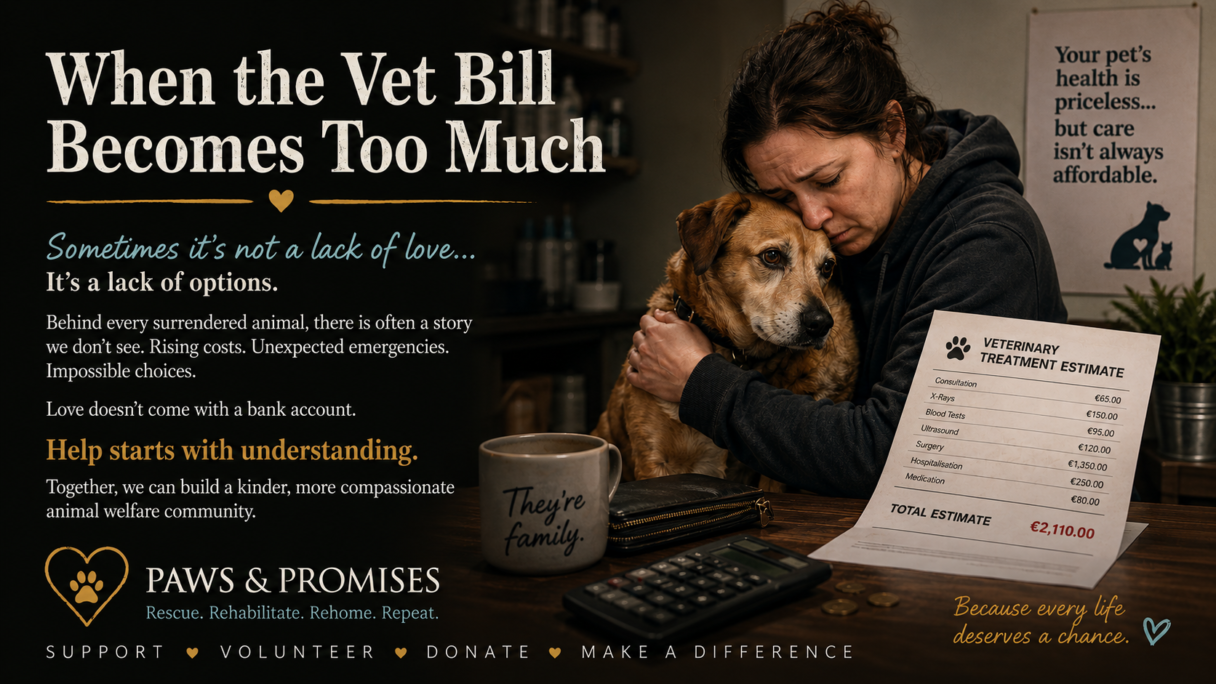
The uncomfortable truth about loving an animal when you can’t afford to save it
We tend to tell ourselves a fairly straightforward story about animal abandonment. Someone gets a dog or a cat, decides they no longer want it, and simply gets rid of it. Perhaps the animal is left at a shelter, abandoned on the roadside, or handed over to a rescue organisation with little explanation beyond the familiar phrase that the owner “can no longer cope”. It is an easy story to understand because it gives us a clear distinction between right and wrong, between the innocent animal and the irresponsible human being who has failed it. Sometimes that is exactly what has happened, of course, and there is no shortage of people who take on animals without giving much thought to the years of responsibility involved. But there is another story which is rather more uncomfortable, because it doesn’t always contain a villain. Sometimes there is simply a person who genuinely loves their animal, a frighteningly large veterinary bill sitting on the kitchen table, and the dawning realisation that love, however sincere, doesn’t come with a bank account attached.
That is the part of animal welfare we don’t talk about nearly enough.
The cost of keeping an animal has risen along with almost everything else. Food costs more, medication costs more, routine veterinary treatment can be surprisingly expensive, and an unexpected illness or injury can transform an ordinary month into a financial crisis. There is a world of difference between budgeting for vaccinations and suddenly being told that your dog needs an operation costing several thousand pounds or euros. For someone with a comfortable income, that may be an unpleasant expense. For somebody already living close to the edge, it can be an impossible one. The animal doesn’t know any of this, of course. It doesn’t understand inflation, pensions, mortgages, energy bills or the peculiar modern phenomenon of discovering that everything you need has somehow become more expensive at precisely the moment your income has remained stubbornly stationary. It simply knows that it is ill, and that the person it trusts is trying to make it better.
That puts an enormous emotional burden on the owner. We quite rightly tell people that taking on an animal is a responsibility for its entire life, and that message needs to remain. Dogs and cats are not disposable possessions and responsible ownership matters. But responsibility does not exist in a vacuum. People lose jobs, relationships break down, illnesses appear, circumstances change and incomes disappear. Someone who could comfortably afford an animal five years ago may find themselves in a completely different financial position today. The dog hasn’t changed. The bond hasn’t necessarily changed either. What has changed is the owner’s ability to pay for what the animal suddenly needs.
And this is where things become particularly uncomfortable, because the modern veterinary profession has become remarkably capable. Animals can receive sophisticated surgery, diagnostic imaging, blood transfusions, cancer treatment, specialist medication and procedures that would have seemed extraordinary only a generation ago. That is an achievement worth celebrating. We have become far better at keeping animals alive and improving their quality of life. The difficulty is that medical capability has a price, and the ability to perform a treatment does not automatically mean that every owner can afford to provide it.
It is also rather unfair to turn the veterinary surgeon into the villain simply because they are the person explaining the bill. Veterinary practices have staff to pay, premises to maintain, equipment to purchase, medicines to stock, insurance, training and all the other costs associated with running a professional medical service. We cannot reasonably expect veterinary practices to become free hospitals simply because their patients have four legs. Most vets went into the profession because they wanted to help animals, not because they had secretly been plotting to become international barons of canine wealth. Yet the result can still be an agonising situation in which the vet knows what could potentially save the animal, the owner desperately wants to authorise the treatment, and neither has an obvious answer to the question of who is going to pay for it.
Sometimes the answer is insurance, although pet insurance has its own complications, exclusions and costs. Sometimes family members step in. Sometimes charities can help. Sometimes a practice is able to offer a payment arrangement or the owner manages to borrow the money. There are occasions when crowdfunding saves an animal that would otherwise have been lost. But none of those options can be assumed, and for every heartwarming success story there are probably many quieter situations where the numbers simply do not work.
That is when the rescue organisation can become involved, and this is where the romantic image of animal rescue begins to collide with reality. Rescue is not simply a matter of taking an unwanted animal somewhere safe and waiting for a kind family to appear. There is food to buy, veterinary treatment to arrange, vaccinations, identification, sterilisation, medication, transport, accommodation and often rehabilitation. There are foster homes to find and applications to process. There are animals with behavioural problems, animals frightened by previous experiences and animals whose medical needs may continue long after the photograph that brought them to public attention has disappeared from social media.
Behind every successful rescue story is usually a rather unglamorous amount of work. Somebody has answered the telephone. Somebody has driven across town. Somebody has cleaned a kennel. Somebody has paid a bill. Somebody has stayed awake worrying about an animal that might not make it through the night. Somebody has asked the public for donations, then asked again because the first appeal didn’t quite cover the cost. Rescue organisations are often operating with limited resources while demand continues to increase, and the idea that there is an endless pool of money somewhere waiting to deal with every abandoned or injured animal is, unfortunately, rather less realistic than the internet would have us believe.
This is why I think we need to broaden the conversation about animal welfare. We quite rightly talk about preventing cruelty and abandonment, but perhaps we should also talk much more openly about what happens before an animal reaches the point of needing rescue. If an owner is struggling financially but still loves their animal, would it not sometimes be better to help that owner keep the animal rather than wait until the situation becomes impossible? A contribution towards emergency treatment, access to affordable veterinary care, assistance with food or medication, subsidised neutering, or even temporary fostering during a particularly difficult period could sometimes prevent a surrender altogether.
None of this is an argument for allowing neglect to continue. If an animal is being abused or is suffering because an owner refuses to provide appropriate care, intervention is necessary. But there is a significant difference between somebody who doesn’t care and somebody who cares deeply but has suddenly found themselves in circumstances they never expected. If we treat both situations as morally identical, we may discourage people from asking for help precisely when asking for help could make the greatest difference.
That matters because people are often reluctant to admit that they cannot afford something. There is still a considerable amount of shame attached to financial hardship, particularly when it involves something we have been told we should have planned for. An owner who is terrified of being judged may delay taking an animal to the vet because they are frightened of being told what the treatment will cost. A relatively manageable condition can then become an emergency, and the eventual cost may be considerably higher. The animal suffers, the owner suffers, and eventually the rescue system may have to deal with a situation that might have been prevented much earlier.
Perhaps the question we should therefore be asking is not simply whether people can afford to own an animal, but whether we have created a system in which the financial consequences of one unexpected event can destroy an otherwise perfectly good relationship between a person and their companion animal. We tell people that animals are family, and I think most people who have lived with one understand exactly what that means. A dog isn’t simply an object that happens to live in the house. A cat isn’t merely an expensive mousetrap with an attitude problem. These animals become woven into the ordinary fabric of daily life. They are there when you get up, there when you come home and often there when everything else has gone slightly pear-shaped.
If we genuinely believe that animals are family, then perhaps our welfare systems need to recognise the human circumstances surrounding them as well. That doesn’t mean removing responsibility from owners. Quite the opposite… it means recognising that responsible ownership sometimes includes admitting that you need help before the situation becomes a crisis.
There is also a wider issue here that deserves some attention. Have we reached a point where keeping a companion animal is becoming a privilege rather than something that ordinary households can reasonably manage? I don’t have a neat answer to that, and I suspect the reality varies enormously depending on where someone lives, what animal they have and what their financial circumstances look like. But it is worth asking. We have encouraged people to regard animals as members of the family while the cost of veterinary medicine, food and general care has increased substantially. At the same time, many households are finding that their own finances are becoming increasingly fragile. It is not unreasonable to wonder what happens when those two realities collide.
The answer cannot simply be to blame the owner. Nor can it be to blame the vet. It certainly cannot be to pretend that rescue organisations have unlimited resources and can absorb every consequence of economic hardship. We need something more practical than that. We need better conversations about preventative care, affordable veterinary services, responsible ownership and the support available to people before they reach breaking point.
Most importantly, we need to recognise that helping an animal does not always mean taking it away.
Sometimes helping an animal means helping the person who loves it.
That may be less dramatic than a rescue van arriving at the gate. It doesn’t produce quite such a compelling photograph, and there is unlikely to be a triumphant social media post announcing that another animal has been saved. But imagine the alternative. An elderly owner gets assistance with medication and keeps the dog that has slept beside them every night for the last twelve years. A family receives temporary help with veterinary costs and doesn’t have to surrender the cat their children have grown up with. Someone who has suddenly lost their income gets support with food for a few weeks and manages to keep their animal until life settles down again.
Those are rescues too.
They simply happen before the animal becomes another statistic.
At PAWS and Promises, that is a conversation I think is worth having. Rescue will always be essential because there will always be animals that genuinely have nowhere safe to go. We will always need foster carers, shelters, volunteers, veterinary professionals, donors and people willing to open their homes to animals that have been abandoned or mistreated. But perhaps the ultimate measure of a good animal welfare system should not only be how many animals we can rescue after something has gone wrong. It should also be how many animals never need rescuing in the first place.
That requires a slightly different way of thinking.
Instead of waiting for the crisis, we look for the pressure building behind it. Instead of asking only why somebody surrendered an animal, we ask whether there was anything that could have been done six months earlier. Instead of assuming that every difficult case is evidence of an irresponsible owner, we take the time to understand what actually happened.
Sometimes there will be no excuse.
Sometimes there will be genuine cruelty.
And sometimes there will simply be a frightened person sitting in a veterinary waiting room, looking at a bill they cannot possibly afford and wondering how on earth they are going to explain to the animal beside them that they have run out of options.
Perhaps that is where compassion needs to begin… not by pretending that responsibility doesn’t matter, but by recognising that sometimes people need a little help carrying it.
Because the best rescue story may not always be the animal that found a new home.
Sometimes it is the animal that never had to leave the old one.





No responses yet