When Rescue Dogs Need Filters
A rescue dog should not need branding optimisation to deserve a home.
A photograph has always carried a strange kind of promise.
Long before algorithms, before artificial intelligence, before social media feeds became endless conveyor belts of polished emotion, people still looked at pictures and quietly built stories around them. A face. A smile. A pair of eyes. We imagine personality from fragments. We project warmth onto still images. Sometimes we fall in love with an idea before we ever meet the reality.
Dog rescue has always depended on this to some extent. A rescue centre uploads a picture of a nervous collie, a tired-looking staffie, or an ageing lurcher curled awkwardly in a kennel, and somewhere a stranger pauses scrolling for just long enough to think:
“Maybe that one.”
But something about the modern internet has altered the emotional contract between image and truth. We now live in a culture where nearly everything is adjusted before being presented. Faces are softened. Skies are brightened. Food is styled beyond recognition. Holidays are edited into emotional theatre productions. Even grief sometimes arrives online with suspiciously good lighting.
And recently, I heard something that sat with me longer than I expected.
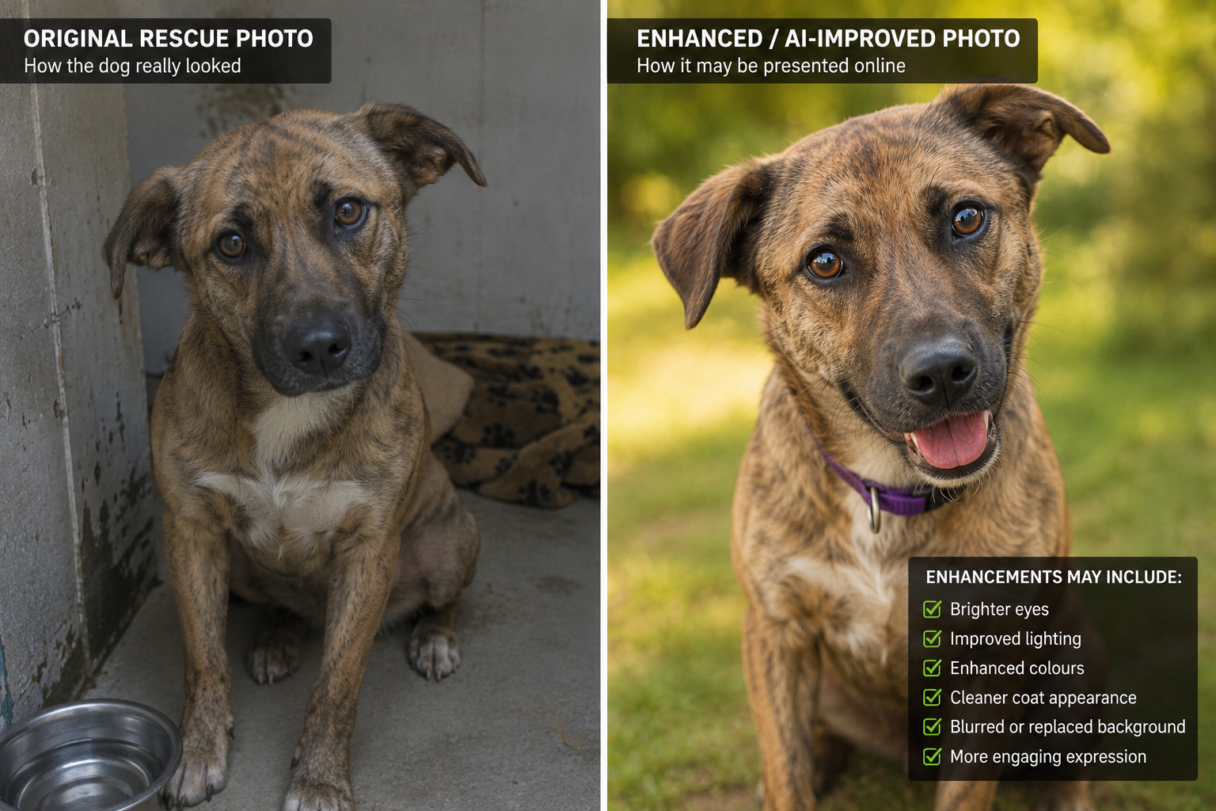
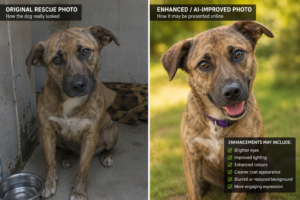
Apparently, one or more dog rescues have begun using AI tools to enhance photographs of dogs up for adoption.
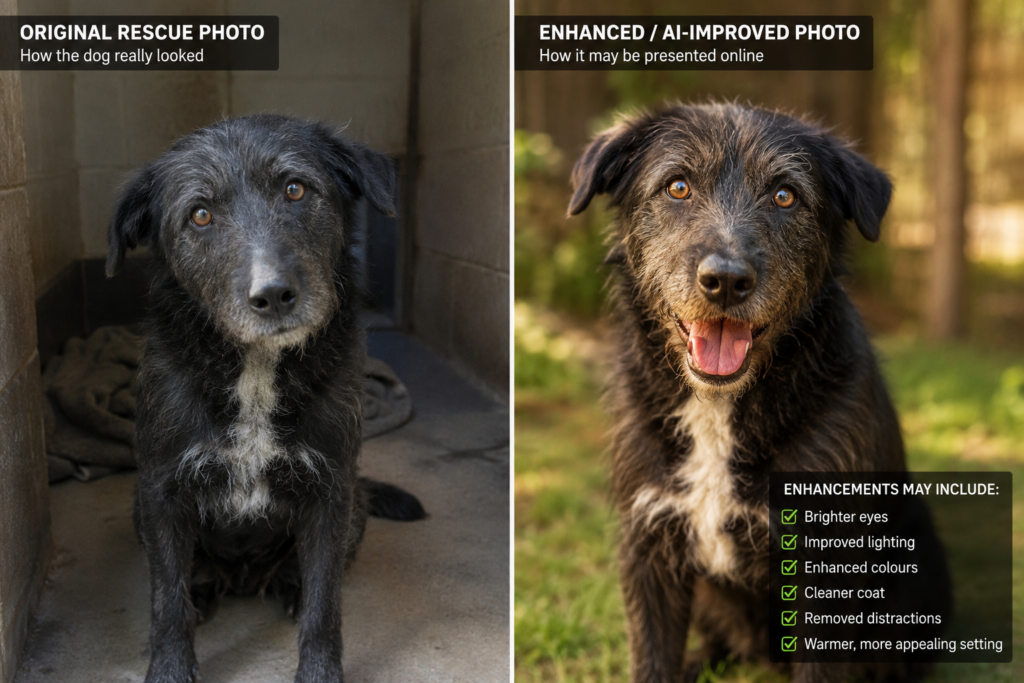
Not necessarily inventing dogs from scratch. Not deepfake puppies wearing sunglasses. More subtle than that. Cleaning up images. Improving lighting. Sharpening eyes. Smoothing coats. Potentially making dogs appear more visually appealing than they really are in person.
And the more I thought about it, the more uncomfortable it became.
Not because technology itself is inherently sinister. Technology is neutral far more often than people admit. The issue is where it enters…and what quietly changes once it does.
Because rescue work is supposed to rest on honesty.
Imagine a couple driving two hours to meet a dog they have already emotionally connected with online. They have looked at the photos repeatedly for days. Perhaps the dog reminded them of one they lost years earlier. Perhaps the expression felt familiar somehow. They arrive hopeful, carrying treats, leads, and optimism.
Then comes that tiny flicker of confusion.
The dog standing in front of them looks older. Rougher. More anxious. More worn down than expected.
Not necessarily unlovable…just different.
That gap matters.
Animal adoption is not like buying a chair online and discovering the colour was slightly off. Rescue placements depend heavily on emotional expectation, trust, and compatibility. The relationship begins before the first physical meeting now. People bond through images first. They imagine temperament, energy, even personality from photographs.
So if AI enhancement alters perception in meaningful ways, even unintentionally, the ethical ground becomes slippery very quickly.
And yet, the uncomfortable truth is that I can also understand how rescues may arrive at this point.
Modern attention is brutal.
Every rescue organisation is now competing inside an economy driven by scrolling behaviour, emotional immediacy, and visual performance. A frightened dog photographed under fluorescent kennel lighting stands little chance against the endless flood of polished content saturating social media every second of the day.
Platforms reward immediate emotional impact. Bright eyes. Clear faces. “Adoptable” aesthetics.
Meanwhile, many rescue workers are exhausted people operating under relentless pressure. Too many animals. Too little funding. Constant urgency. Constant emotional fatigue. They are trying to save lives within systems increasingly shaped by visibility metrics.
And visibility now determines value far more than most people are comfortable admitting.
The dogs least likely to photograph well are often the ones most desperately needing homes.
The elderly dogs with cloudy eyes.
The nervous dogs shrinking into corners.
The scarred dogs.
The dogs with patchy fur, awkward proportions, damaged ears, or tired expressions that tell the truth of what they have survived.
There is something quietly heartbreaking about the possibility that even abandoned animals may now need aesthetic enhancement to compete for compassion.
Even rescue dogs, it seems, are not fully safe from branding culture.
That sentence alone says something unsettling about the direction of modern life.
Because this is not really just about dogs.
It is about what happens when every corner of society slowly absorbs the logic of presentation culture. The same pressures that shape influencers, advertising, and online identity are beginning to seep into spaces that once relied upon raw authenticity.
We have reached a strange point historically where reality itself is often considered insufficiently persuasive.
A real sunset is no longer enough without colour grading.
A real meal is no longer enough without staging.
A real face is no longer enough without filtering.
And now, perhaps, in some cases, a real rescue dog is no longer enough without enhancement.
The saddest part is that rescue, at its core, should represent the exact opposite of this mentality.
Adoption is fundamentally about accepting imperfection.
A rescue dog is not supposed to arrive as a polished product. The scars matter. The nervousness matters. The uncertainty matters. Those things are not flaws in the story…they are the story.
Sometimes the most moving photographs are precisely the imperfect ones. The badly lit kennel image. The cautious expression. The dog who looks unsure whether humans can still be trusted. Those images carry emotional honesty that no AI-enhanced softness can truly replicate.
In fact, authenticity may ultimately be the thing people crave most now.
The internet has become so saturated with optimisation that truth itself has started feeling refreshing again. A genuine photograph of a weary rescue dog can cut through the noise far more deeply than something polished to algorithmic perfection.
People do not merely want perfection anymore. Increasingly, they want something real enough to believe in.
And perhaps that is the bigger risk here.
Not simply misleading photographs, although that matters.
Not merely disappointment upon arrival, although that matters too.
The larger danger is the erosion of trust in places where trust matters enormously.
Rescue organisations occupy a rare emotional space in society. People want to believe these places operate from sincerity rather than performance. The moment presentation becomes more important than truthful representation, even for understandable reasons, something fragile begins to crack.
Whether this practice is isolated or quietly spreading is almost secondary to the wider question it raises.
If compassion itself must now compete through optimisation, what happens to everything that cannot perform well visually?
What happens to the dogs too old, too damaged, too frightened, or too ordinary to thrive inside an attention economy?
And what does it say about us that even abandoned animals may now need help appearing worthy of love?
Perhaps the answer is not better enhancement technology.
Perhaps the answer is remembering what rescue was supposed to mean in the first place.
Not perfection.
Not presentation.
Not emotional marketing polished by artificial intelligence.
Just truth…offered honestly…and the hope that somebody will still choose to care.



No responses yet